arXiv: Programming quantum circuits in a complex medium

Experimental setup and results for a five-dimensional discrete Fourier gate

In a recent paper on the arXiv, we show how high-dimensional quantum optical circuits can be programmed inside a commercial multi-mode fibre through the use of inverse-design techniques. Using these methods, we were able to demonstrate the transport, manipulation, and measurement of high-dimensional photonic entanglement by using the transmission channel itself!

We also present numerical results on the scalability of our approach, showing how the resource of a high-dimensional mode-mixer allows perfect and lossless circuits to be realised in principle. By harnessing something as simple as light scattering inside a multi-mode fibre, our work serves as a new, yet practical alternative to integrated photonic platforms.

This work was done in collaboration with our QuantERA project partners Claudio Conti (La Sapienza, Rome) and Pepijn Pinkse (Uni Twente, Netherlands). We look forward to many more exciting collaborations in the future!
arXiv: Noise-robust and loss-tolerant quantum steering with qudits

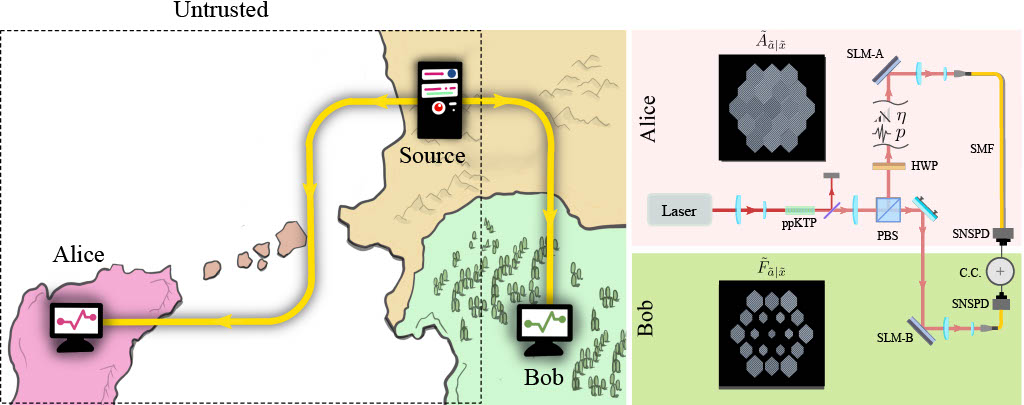
Our new quantum steering protocol for single-detectors brings us a step closer towards secure one-sided device-independent quantum communication over realistic channels.

In our latest work on arXiv, we experimentally demonstrate detection-loophole-free quantum steering with qudits under extreme conditions of loss and noise. This work was done in collaboration with the Quantum Information Theory Group at the University of Geneva.

We showcase the improvements over qubit-based systems by experimentally demonstrating detection loophole-free quantum steering in 53 dimensions through simultaneous loss and noise conditions corresponding to 14.2 dB loss equivalent to 79 km of telecommunication fibre and 36% of white noise. We further show how the use of high dimensions counter-intuitively leads to a dramatic reduction in total measurement time. Our work demonstrates that qudit-entanglement can transcend the limits imposed by a realistic and noisy environment, proving itself a critical ingredient for making device-independent quantum communication over long distances a reality.

arXiv: Introducing the collected joint-transverse-momentum-amplitude

The knowledge of the collected joint-transverse-momentum-amplitude (JTMA) allows us to choose and tailor appropriate discrete variable bases to harness high-dimensional entanglement.

In a recent article published on arXiv, we have formalised the description for a two-photon position-momentum entangled state generated through spontaneous-parametric-down-conversion, referred to as the collected joint-transverse-momentum-amplitude (JTMA). This function characterizes the bi-photon state in the momentum degree-of-freedom while incorporating the effects of both the generation and measurement systems.

In this work, we formulate a theoretical model, propose a practical and efficient method to accurately reconstruct the collected JTMA, and demonstrate our technique by implementing it on two experiments in the continuous-wave near-infrared and pulsed telecom wavelength regimes. Furthermore, we discuss how accurate knowledge of the collected JTMA enables us to generate tailored discrete-variable high-dimensional entangled states that maximise metrics relevant to quantum information processing

Check out all the details and results in our pre-print: https://arxiv.org/abs/2110.03462 .

Journal of Optics : Entangled ripples and twists!

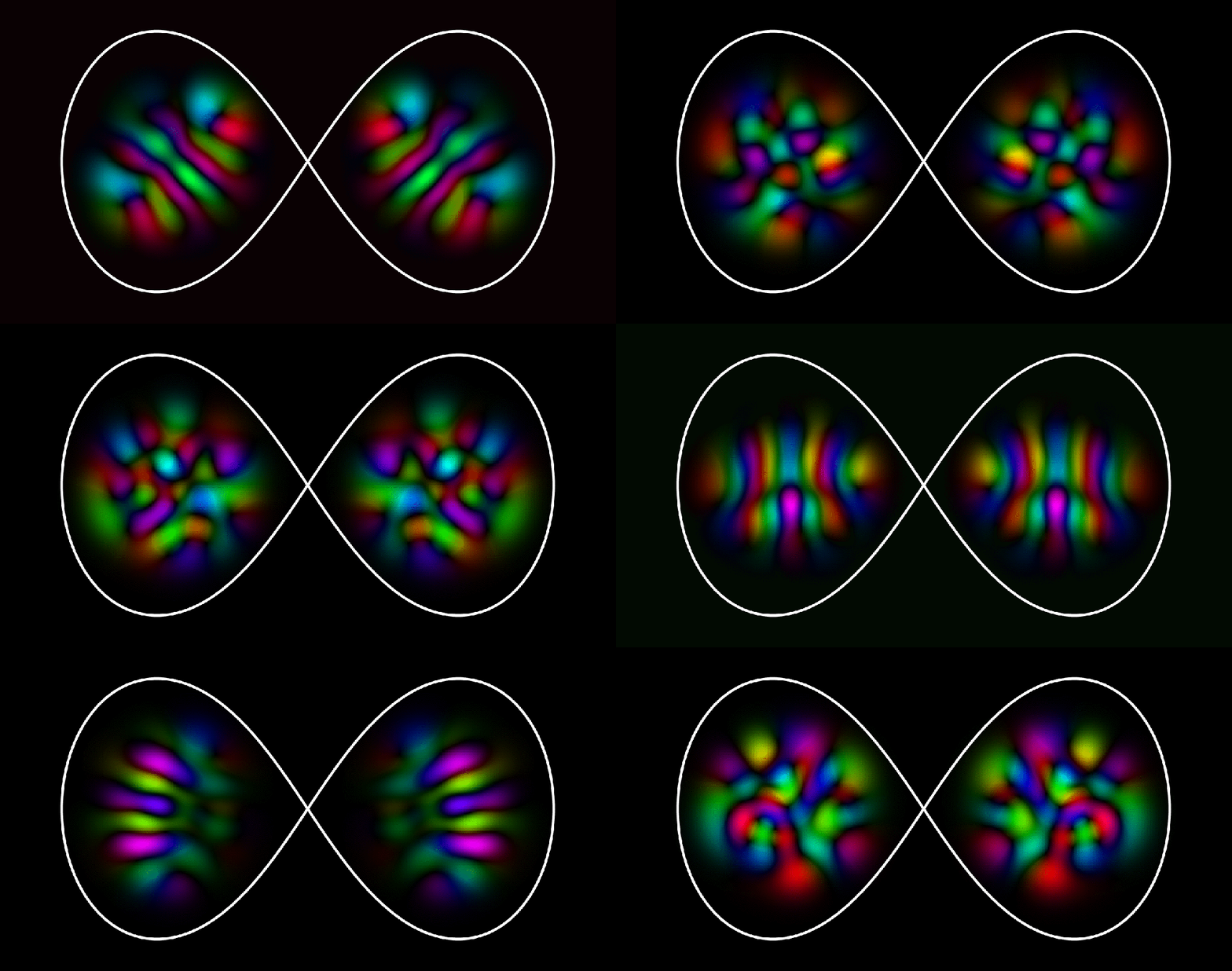
Artist’s depiction of entangled Laguerre-Gaussian modes in 43 dimensions

In a recent article published in IOPscience Journal of Optics (Emerging Leaders Special Issue) we demonstrate the full-field entanglement of radial (ripples) and azimuthal (twists) Laguerre-Gaussian modes of light. While the azimuthal degree-of-freedom has attracted a lot of interest over the past two decades, the radial degree-of-freedom presents some unique challenges to experimentalists.

By carefully tuning our optical system parameters and adopting some recently developed techniques for precise spatial mode measurement, we generated and measured entanglement in a 43-dimensional radial and azimuthal LG mode space. We also studied two-photon quantum correlations between 9 LG mode groups, which are of significant interest in the field of fibre optics.

Science Advances: Quantum Conference Key Agreement

Most of us have spent an inordinate amount of time over the past year in online conference calls, which are sure to become a regular feature in our lives. Recent events such as the ransomware attacks on US energy firms have highlighted more than ever the need for information security in such electronic forms of communication.

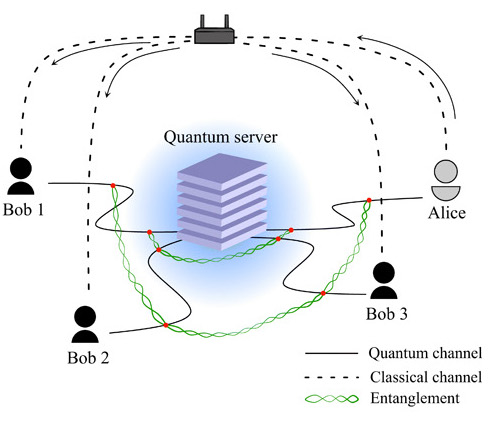
In a collaboration with the Mostly Quantum Lab at Heriot-Watt, we demonstrated the first quantum-secure conference call between four users. Using a multi-photon entangled GHZ state distributed over fiber-optic cables with a combined length of 50km, we built a secure key between four parties and used it to share an image of the Cheshire cat. It won’t be long before the first quantum-secure Zoom call!

See the original publication in Science Advances or media coverage in the journal Nature and Physics World magazine for more details.