BBQLab @ ICOAM2022

Tampere, Finland at 11:30 PM!

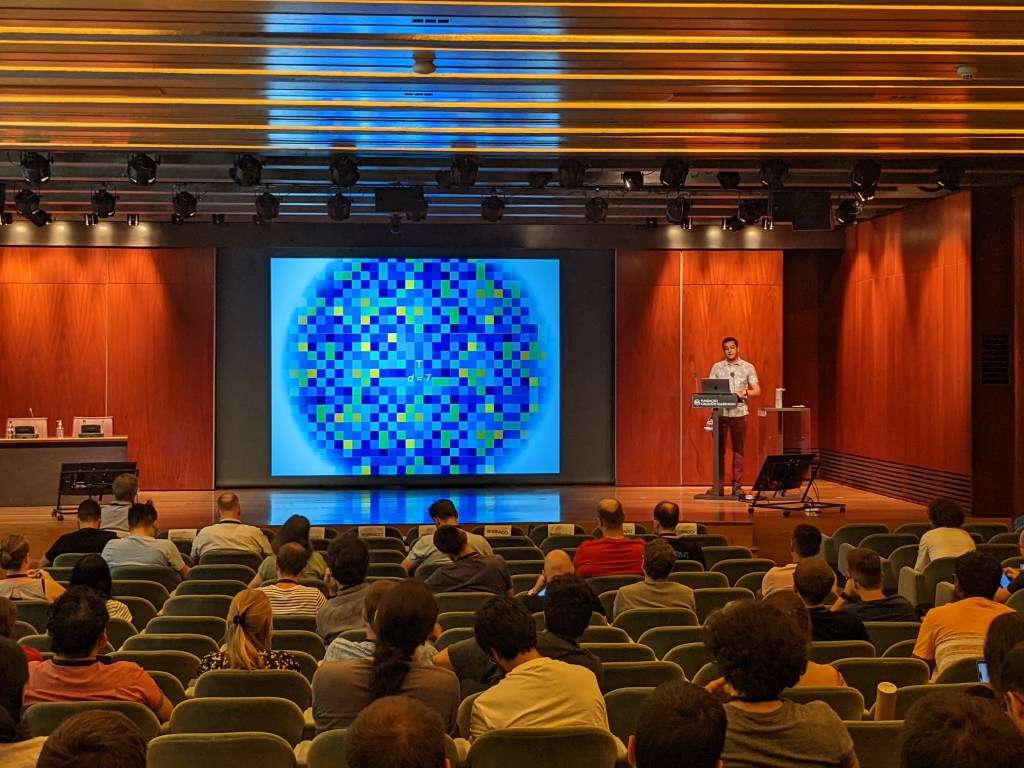
Natalia and Mehul recently represented BBQLab at the 6th International Conference on Optical Angular Momentum in Tampere, Finland. It was a fantastic event, bringing together a diverse group of researchers from around the world working on structured photons, electrons, ions, and neutrons! Natalia won the second prize in the hotly contested ICOAM poster competition for her submission on entangled ripples and twists of light. Mehul presented an invited talk on our recent work on programming high-dimensional quantum optical circuits inside a complex medium. We are looking forward to ICOAM2024 in South Africa!

Congratulations to Natalia for winning 2nd prize in the ICOAM poster competition!
One of the many beautiful lakes around Tampere (photo taken from the Viikinsaari island, venue for the ICOAM conference dinner)

BBQLab @ BQIT:22

BBQLab descended on Bristol for Bristol Quantum Information Technologies Workshop 2022 to enjoy a fantastic week of seminars, poster sessions, networking events and engagement with the scientific community – and beautiful Bristol.

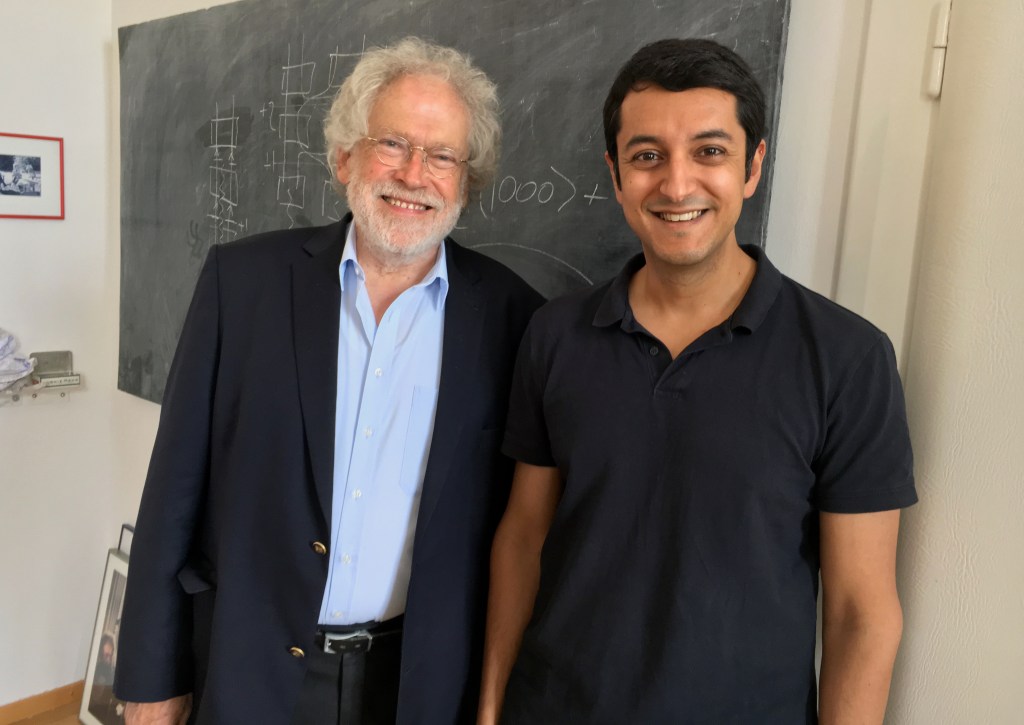
Congratulations to Vatshal Srivastav (left) and Suraj Goel (right) for winning the People’s Choice Poster Prize, gaining over 50% of peoples votes! Brilliant follow-up to Vatshal’s win in BQIT: 2021.

As well as an inspiring Equality, Diveristy and Inclusion session on imposter syndrome in academia and the impact of the COVID-19 pandemic featuring our group leader Prof Mehul Malik, and co-chaired by our Sophie Engineer.

All in all, a wonderful opportunity for all nine of our team to step out of the virtual and into real life. Bring on more conferences, workshops and prizes!

arXiv: Programming quantum circuits in a complex medium

Experimental setup and results for a five-dimensional discrete Fourier gate

In a recent paper on the arXiv, we show how high-dimensional quantum optical circuits can be programmed inside a commercial multi-mode fibre through the use of inverse-design techniques. Using these methods, we were able to demonstrate the transport, manipulation, and measurement of high-dimensional photonic entanglement by using the transmission channel itself!

We also present numerical results on the scalability of our approach, showing how the resource of a high-dimensional mode-mixer allows perfect and lossless circuits to be realised in principle. By harnessing something as simple as light scattering inside a multi-mode fibre, our work serves as a new, yet practical alternative to integrated photonic platforms.

This work was done in collaboration with our QuantERA project partners Claudio Conti (La Sapienza, Rome) and Pepijn Pinkse (Uni Twente, Netherlands). We look forward to many more exciting collaborations in the future!

Congratulations Natalia!

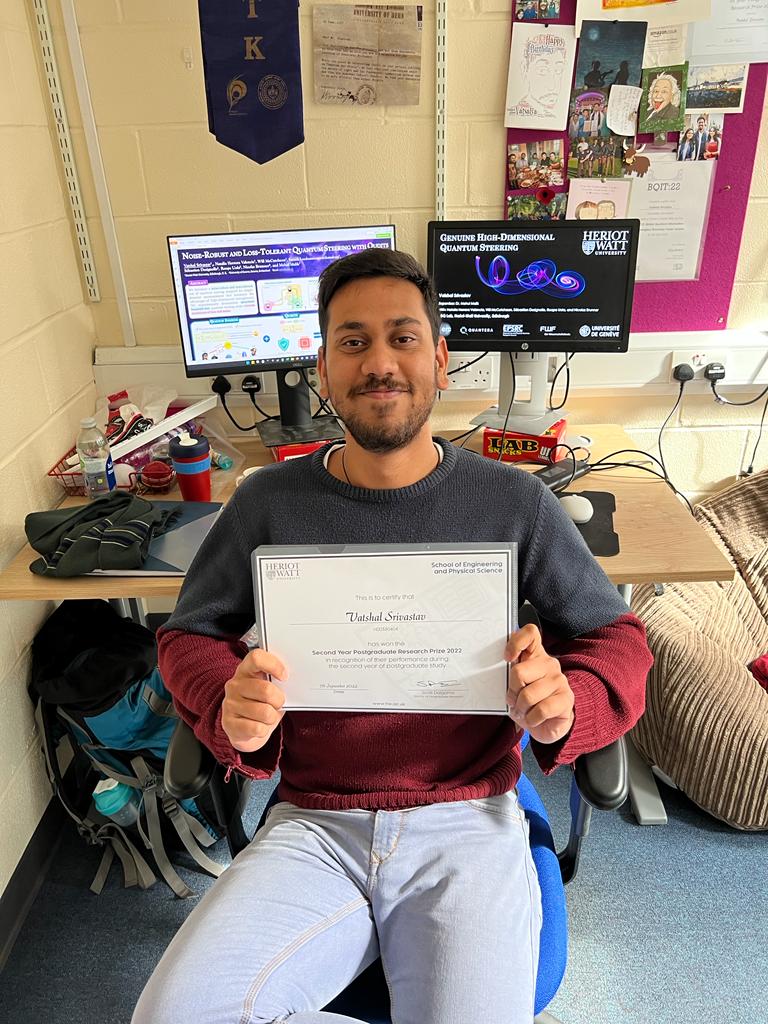
We are very proud to announce a major achievement of our PhD student Natalia Herrera. She won the 2nd-year prize and the best talk award at the annual Postgraduate Research Conference in the School of Engineering and Physical Sciences at Heriot-Watt University. This acknowledges the fantastic talks she gives to a wide range of audiences and her passion to share her expertise.


Natalia has made outstanding achievements in the lab during her PhD as is shown by her latest Nature Physics paper titled “Unscrambling entanglement through a complex medium.” Our proud winner felt very honoured by taking home two prizes and will spend the prize money on time with her friends and family in 2022.

arXiv: Noise-robust and loss-tolerant quantum steering with qudits

Our new quantum steering protocol for single-detectors brings us a step closer towards secure one-sided device-independent quantum communication over realistic channels.

In our latest work on arXiv, we experimentally demonstrate detection-loophole-free quantum steering with qudits under extreme conditions of loss and noise. This work was done in collaboration with the Quantum Information Theory Group at the University of Geneva.

We showcase the improvements over qubit-based systems by experimentally demonstrating detection loophole-free quantum steering in 53 dimensions through simultaneous loss and noise conditions corresponding to 14.2 dB loss equivalent to 79 km of telecommunication fibre and 36% of white noise. We further show how the use of high dimensions counter-intuitively leads to a dramatic reduction in total measurement time. Our work demonstrates that qudit-entanglement can transcend the limits imposed by a realistic and noisy environment, proving itself a critical ingredient for making device-independent quantum communication over long distances a reality.