PRX: Loss and Noise-robust Quantum Steering

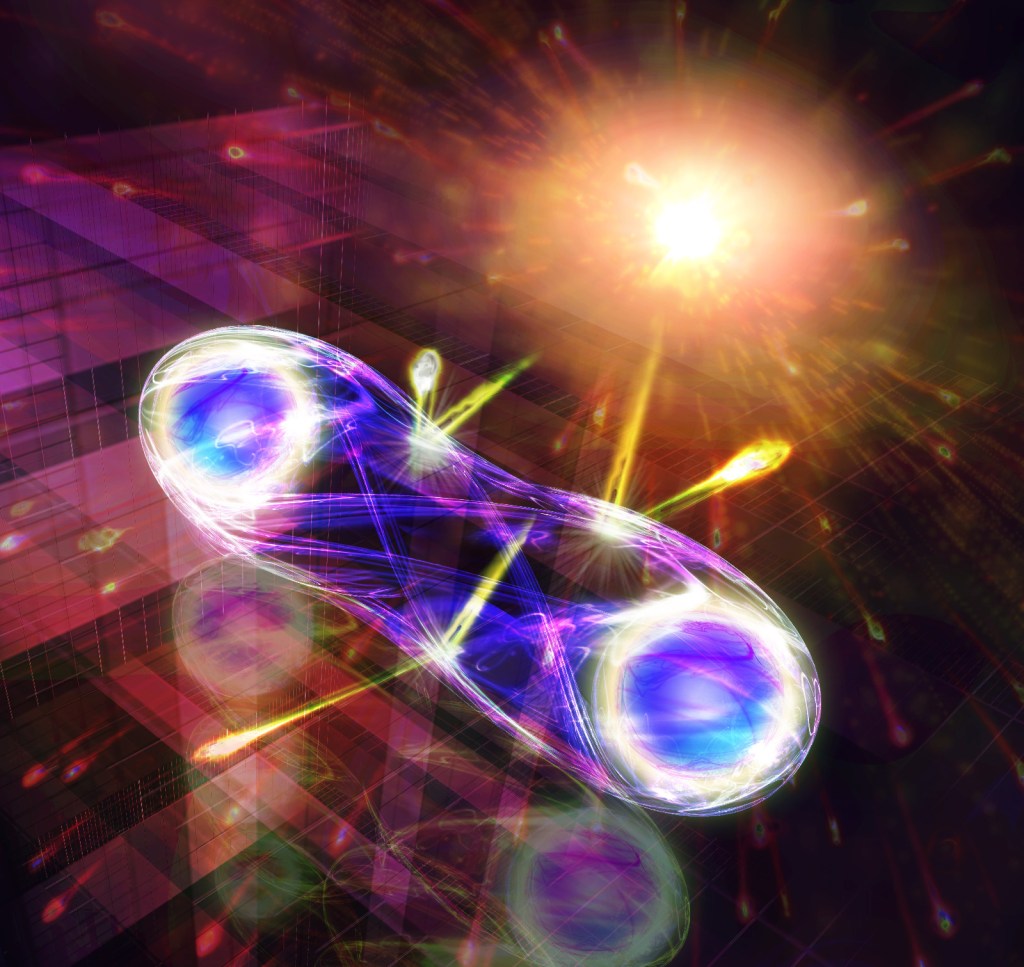
Our resident artist’s depiction of high-dimensional entanglement that is simultaneously robust to noise and loss (Credit: Vatshal Srivastav)

We are very excited to share our new publication, “Quick Quantum Steering: Overcoming Loss and Noise with Qudits,” which was published today in the leading APS journal Physical Review X!

Quantum steering is a phenomenon in quantum physics that occurs when two parties, say Joe and Rishi, share an entangled state—a state of two particles that is strongly correlated, no matter how far apart the particles are. By making specific measurements on his particle in London, Rishi can then “steer” the quantum state of Joe’s particle in Washington to behave a certain way. The physicist Erwin Schrodinger called this steering of the wavefunction “magic,” as it forces Joe to believe that Rishi can influence his particle from a distance (it is important to note that Rishi cannot transfer any information instantaneously to Joe in this manner).

However, this form of entanglement is also easily destroyed in a realistic environment that includes loss and noise, which limits its use in applied scenarios such as quantum communication. In this work, we develop a new theoretical test of quantum steering that not only works under massive amounts of loss and noise, but can also be performed very quickly. We were able to demonstrate it in the lab by harnessing the inherent high-dimensional nature of light—photons entangled in their spatial structure.

Our results are significant for the development of practical quantum communication technologies. Even the best optical fibres in the world suffer from a certain amount of loss, which puts strict limitations on the distance over which entanglement-based quantum communication can be carried out. Having a loss-tolerant method for steering entanglement opens a pathway towards practical quantum communication networks with the ultimate form of security. The simultaneous ability to withstand noise could also allow such networks to operate over our existing telecommunications links, which would carry noisy classical traffic at the same time.

This work received media coverage in 145 news outlets (a new BBQLab record!) and was done in collaboration with our close collaborators Prof. Nicolas Brunner, Dr. Roope Uola, and Sebastien Designolle at the University of Geneva, Switzerland. See selected coverage of our work in APS Physics Magazine, UKRI News, The Independent, London Evening Standard, and The Daily Mail.

HW Press release: Quantum leap for Heriot-Watt research into unhackable communications networks
Journal reference: V. Srivastav et al, “Quick Quantum Steering: Overcoming Loss and Noise with Qudits,” Physical Review X 12, 041023 (2022), DOI: 10.1103/PhysRevX.12.041023.
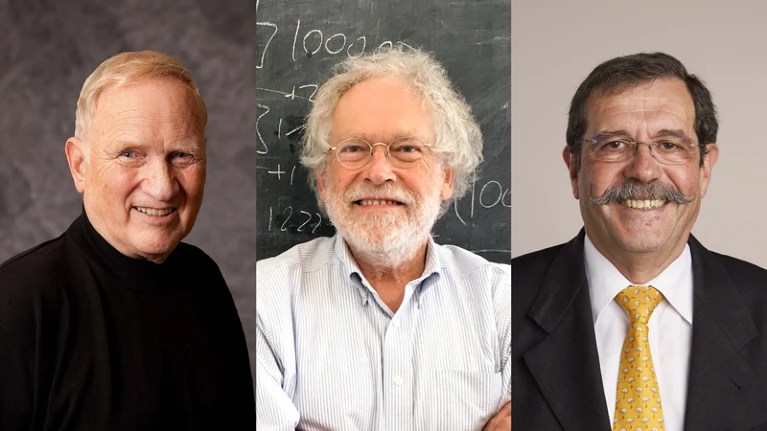
And the 2022 Nobel Prize goes to…

John Clauser, Anton Zeilinger and Alain Aspect have won this year’s Nobel physics prize for their research on quantum entanglement

We would like to congratulate Alain Aspect, John Clauser, and Anton Zeilinger for winning the 2022 Nobel Prize in Physics! The prize was awarded for “experiments with entangled photons, establishing the violation of Bell inequalities and pioneering quantum information science”—a very exciting development for our field!

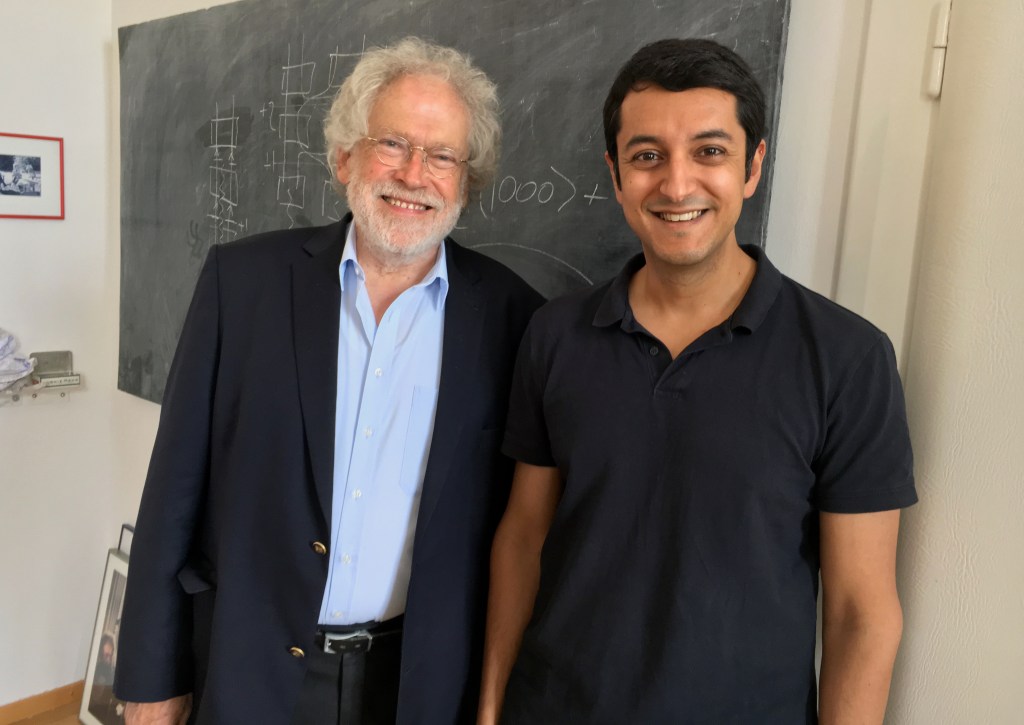
Congratulations Anton!

A very special congratulations goes out to Professor Zeilinger, whom Mehul spent several years working with in Vienna, before moving to Edinburgh and starting the BBQ Lab. In recognition of the award, the Nature portfolio of journals has put together a beautiful collection of articles by the awardees and advances they have inspired. We are pretty chuffed to see four of our papers in there (two authored with Anton, and two from our group at Heriot-Watt)!

Nature Physics: Unscrambling Entanglement

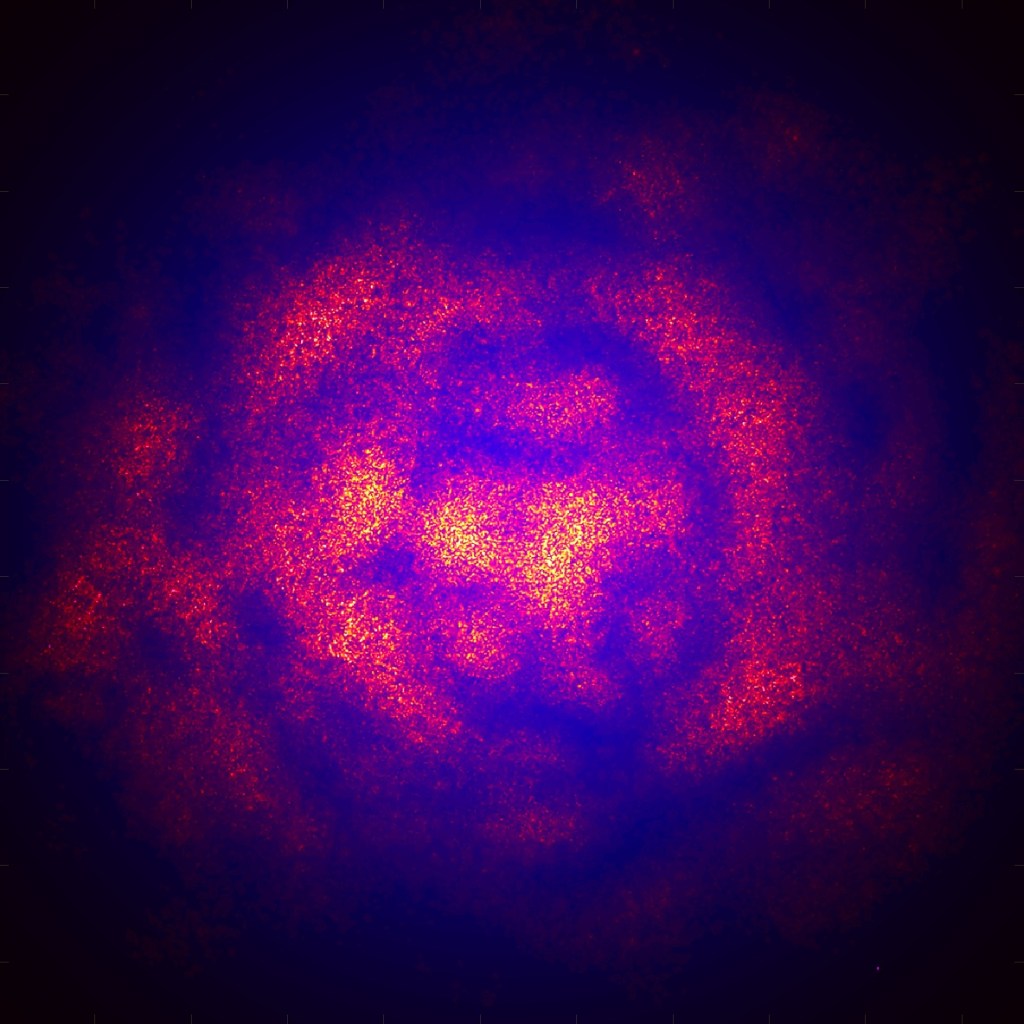
A chaotic speckle pattern that results from light being scrambled by a complex medium such as a multimode optical fibre. (Image credit: M. Malik and S. Goel)

In new work from our lab published in the journal Nature Physics, we demonstrate how high-dimensional entanglement can be transported through a complex medium consisting of a commercial multi-mode fibre supporting hundreds of spatial modes. This work was done in collaboration with Dr. Hugo Defienne from University of Glasgow.

In a quantum twist, the transmission matrix of the fibre was measured by mapping the entire matrix onto a single entangled state, which is an example of state-channel duality in quantum mechanics. Furthermore, the entanglement was regained without ever manipulating the fibre or the photon that entered it. Instead, we carefully scrambled the entangled partner that remained outside, allowing us to transport 6-dimensional entanglement through the fibre!

Popular media coverage: BBC News, Physics World, Physics Today, Heriot-Watt press release

N. H. Valencia, S. Goel, W. McCutcheon, H. Defienne, & M. Malik, Unscrambling Entanglement through a Complex Medium, Nature Physics (2020), doi: 10.1038/s41567-020-0970-1.

PRX: Entanglement beats the Noise

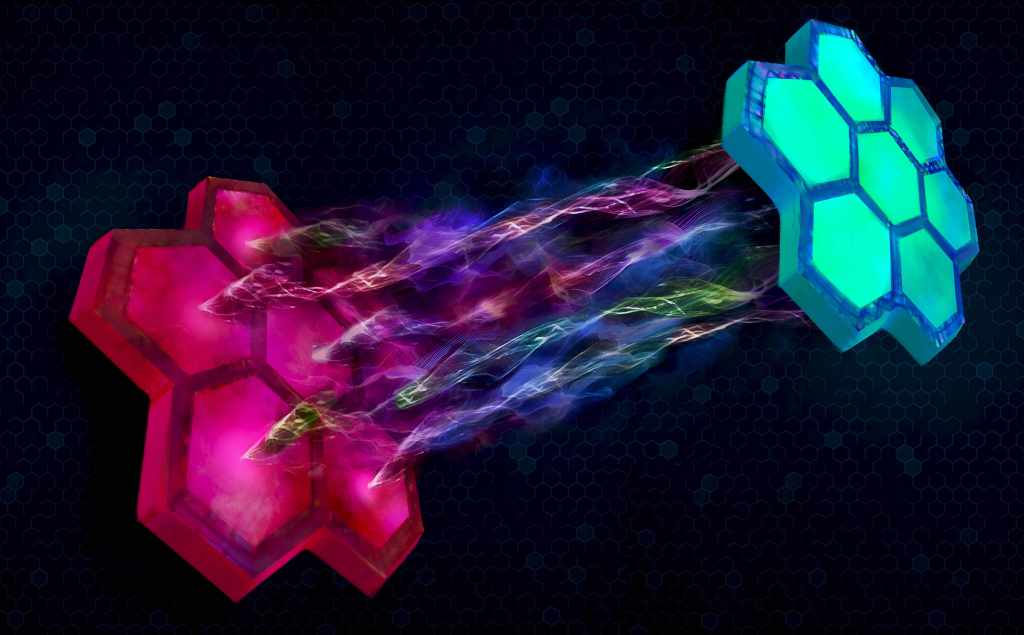
Artist’s depiction of entanglement surviving the onslaught of noise!
(Image credit: Harald Ritsch for IQOQI Vienna)

In our new paper on “Overcoming Noise in Entanglement Distribution” co-authored with colleagues in Austria, Finland, Germany, and Canada, we demonstrate how high-dimensional entanglement in the spatio-temporal degrees of freedom allows one to tolerate large amounts of noise that would generally lead to a loss of qubit, or two-dimensional entanglement. In other words, we certified entanglement with the laboratory lights on! This works demonstrates the potential for high-dimensional quantum states to not only enable high-capacity quantum networks, but also operate in realistic environmental conditions, such as in broad daylight or alongside classical data traffic. For more information, please read this APS synopsis.

Popular media coverage: Heriot-Watt press release, Wiener Zeitung, Orf.at.
Journal reference: Ecker et al, Phys. Rev. X 9, 041042 (2019), doi: 10.1103/PhysRevX.9.041042.

Entanglement Certification in Nature Reviews Physics

Image credit: Christian Murzek 2018 Murzek.com

After a long and arduous trans-channel effort between Edinburgh and Vienna, our review on entanglement certification is out in the journal Nature Reviews Physics!

This review attempts to bridge the language gap between the theory and experiment, and exemplifies the academic space where our group most likes to work—a harmonious blend of quantum information theory, quantum photonics, and lots of good coffee of course!

Check out Nature’s On Your Wavelength blog for a really nice piece by Marcus on how this review came together.