Bienvenu, Xavier!

Introducing Xavier Toisoul, our latest addition from Erquy, France, joining BBQ Lab for his internship.

Xavier is a Physics and Chemistry major from École Centrale de Marseille, and he will explore the universe of quantum optics and complex media with us. His interests span Web 3.0, calisthenics, and the intricate world of Forex trading. He enjoys listening to music in his downtime and relishing Breton delights like Kouign-Amann.

Let’s warmly welcome Xavier and make this journey one for the books!

Welcome Kesini!

A warm welcome to Kesini Chumphuthong, our newest visitor!

Hailing from the beautiful city of Songkhla in Thailand, Kesini is here for her internship in quantum optics while pursuing her undergraduate studies at Prince of Songkhla University. With a keen interest in quantum optics and multi-plane light converters, Kesini also enjoys recreating delicious Thai recipes and exploring new places in her free time.

Welcome aboard, Kesini! We’re thrilled to have you at BBQ Lab.

Natalia wins top Uni Prize!

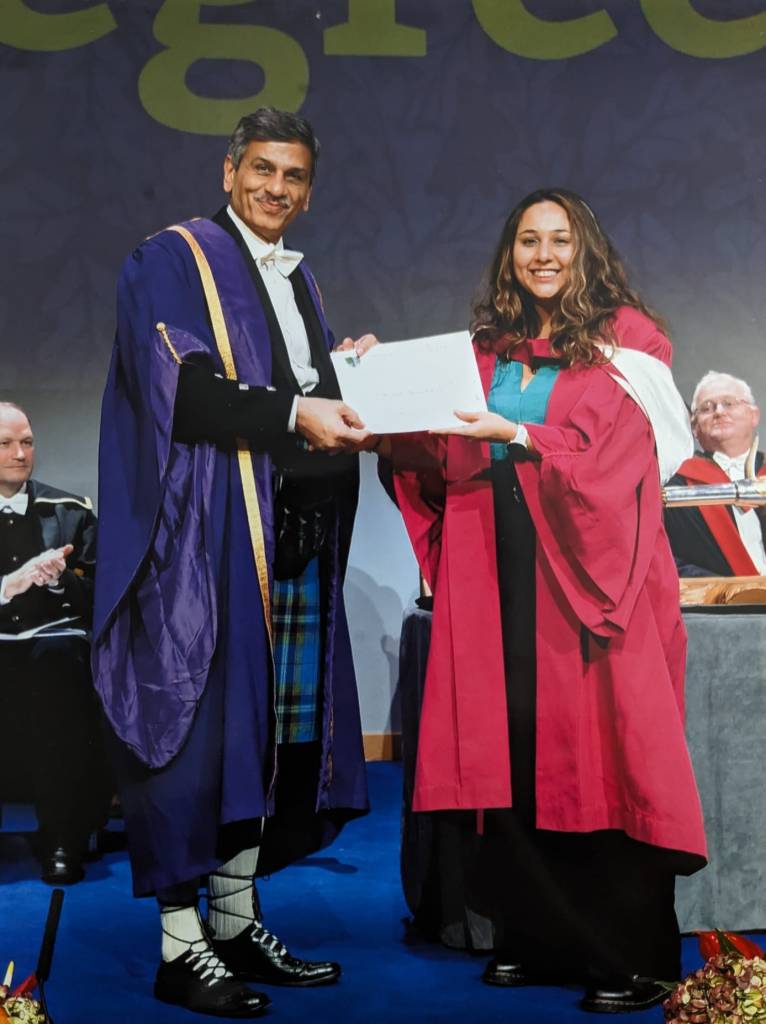
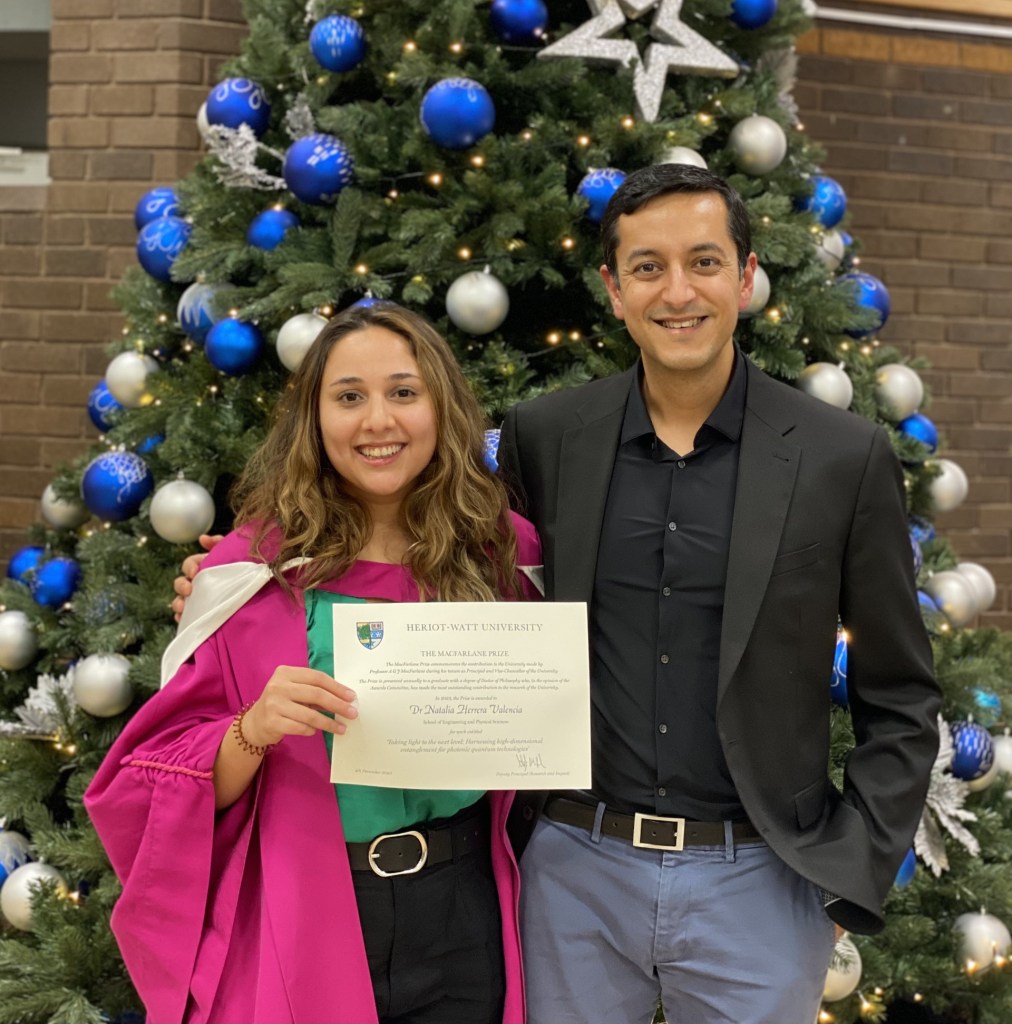
We are thrilled to announce that our stellar postdoc, Dr. Natalia Herrera Valencia, has won Heriot-Watt University’s top research prize for her groundbreaking PhD dissertation on high-dimensional entanglement. This recognition is another jewel in her crown, a testament to Natalia’s contributions to the field of quantum information and communication.

Her remarkable journey is marked by an impressive collection of 10 published papers, including three highly cited first-author publications. These contributions have garnered over 500 citations to date, showcasing her exceptional impact at this early stage in her career.

Natalia’s thesis includes the demonstration of the unprecedented transport of quantum entanglement through a complex medium—a result that was featured on the cover of Nature Physics. It also caught the eye of the global media, including outlets such as BBC News. Congrats Natalia!

PR Applied: Characterizing and tailoring multimode SPDC

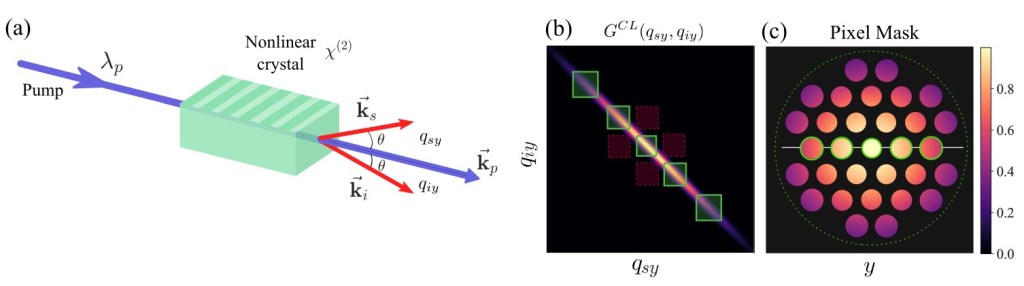
(a) The process of spontaneous parametric down-conversion (SPDC) generates a two-photon wavefunction entangled in transverse position-momentum (b) We show how to measure this wavefunction efficiently and use it to tailor high-dimensional entangled states.

We are pleased to announce the publication of ‘Characterizing and Tailoring Spatial Correlations in Multimode Parametric Down-Conversion’ in Physical Review Applied. In this article, we have developed a detailed theoretical model for the quantum state of two photons entangled in their transverse position and momentum. Our model incorporates the systems used for generating entanglement and measuring it, both of which play a significant role in what the final two-photon entangled state looks like. We introduce and demonstrate a simple and efficient method to quickly characterise the two-photon joint-transverse-momentum amplitude (JTMA) using scanned phase-only holograms. We use knowledge of the JTMA to precisely tailor discrete, high-dimensional entangled states of light in the Laguerre-Gaussian (LG) and Pixel bases. We expect our work to have wide-ranging applications in experiments on multi-mode SPDC, as well as for entanglement-based quantum technologies for communication, imaging, and computation.

arXiv: Noise-robust and loss-tolerant quantum steering with qudits

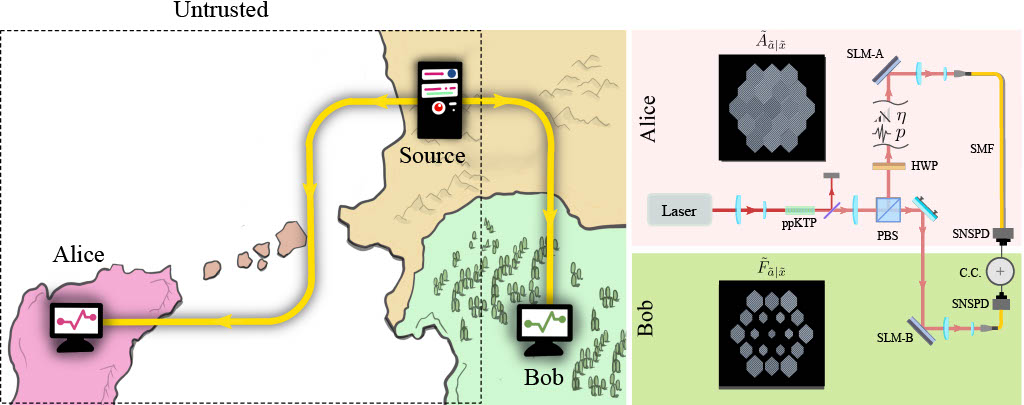
Our new quantum steering protocol for single-detectors brings us a step closer towards secure one-sided device-independent quantum communication over realistic channels.

In our latest work on arXiv, we experimentally demonstrate detection-loophole-free quantum steering with qudits under extreme conditions of loss and noise. This work was done in collaboration with the Quantum Information Theory Group at the University of Geneva.

We showcase the improvements over qubit-based systems by experimentally demonstrating detection loophole-free quantum steering in 53 dimensions through simultaneous loss and noise conditions corresponding to 14.2 dB loss equivalent to 79 km of telecommunication fibre and 36% of white noise. We further show how the use of high dimensions counter-intuitively leads to a dramatic reduction in total measurement time. Our work demonstrates that qudit-entanglement can transcend the limits imposed by a realistic and noisy environment, proving itself a critical ingredient for making device-independent quantum communication over long distances a reality.