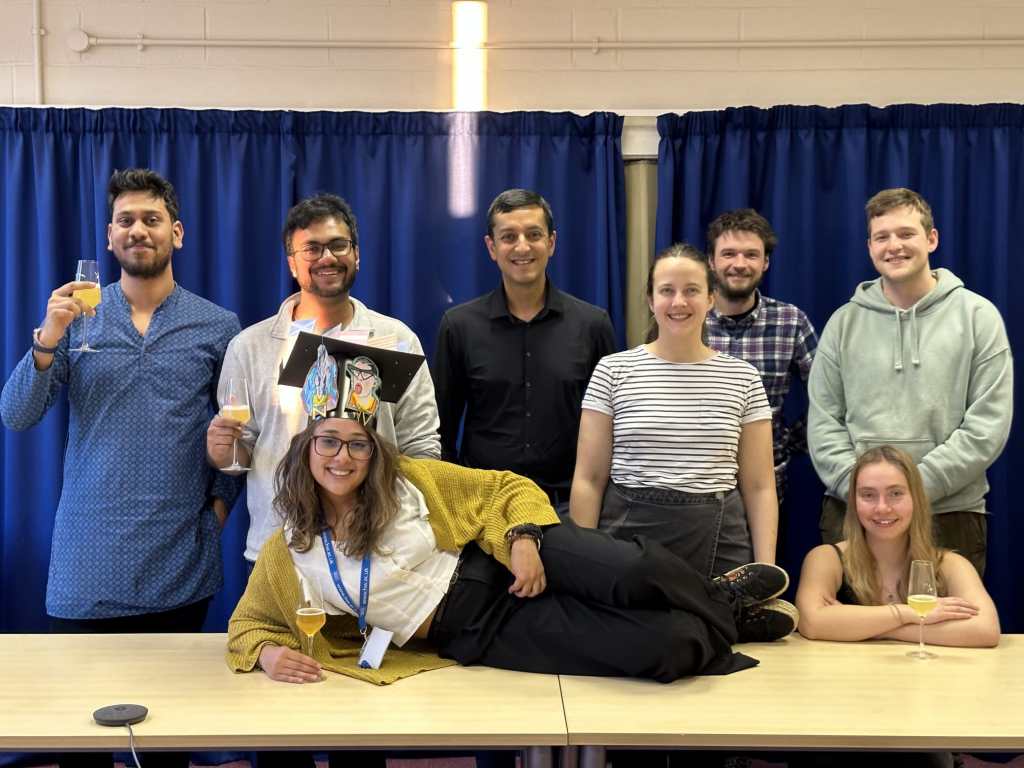
A huge congratulations to Dr. Natalia Herrera Valencia for successfully defending her PhD thesis! Natalia joined us in 2019 following a Europhotonics Erasmus Mundus Masters. Her thesis work has focused on the development of a new platform for high-dimensional entanglement and its unprecedented transport through a complex scattering medium. Natalia will continue as a postdoctoral research associate in BBQLab and we are very pleased that she is staying with us for some more time!
Poster advertising Natalia’s PhD seminar, designed by the talented Vatshal Srivastav
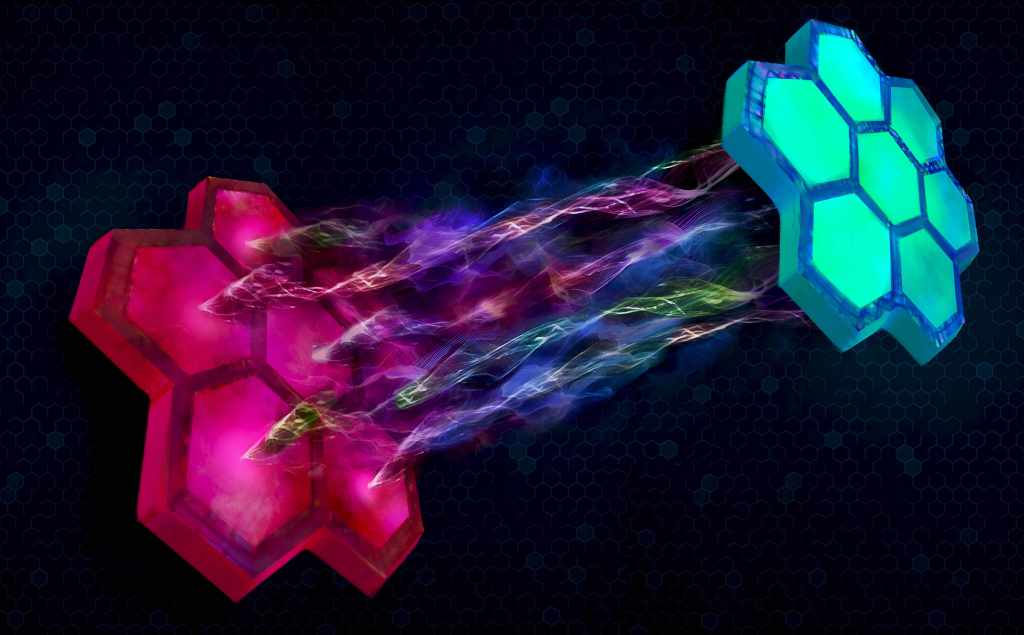
Quantum steering is a phenomenon in quantum physics that occurs when two parties, say Joe and Rishi, share an entangled state—a state of two particles that is strongly correlated, no matter how far apart the particles are. By making specific measurements on his particle in London, Rishi can then “steer” the quantum state of Joe’s particle in Washington to behave a certain way. The physicist Erwin Schrodinger called this steering of the wavefunction “magic,” as it forces Joe to believe that Rishi can influence his particle from a distance (it is important to note that Rishi cannot transfer any information instantaneously to Joe in this manner).
However, this form of entanglement is also easily destroyed in a realistic environment that includes loss and noise, which limits its use in applied scenarios such as quantum communication. In this work, we develop a new theoretical test of quantum steering that not only works under massive amounts of loss and noise, but can also be performed very quickly. We were able to demonstrate it in the lab by harnessing the inherent high-dimensional nature of light—photons entangled in their spatial structure.
Our results are significant for the development of practical quantum communication technologies. Even the best optical fibres in the world suffer from a certain amount of loss, which puts strict limitations on the distance over which entanglement-based quantum communication can be carried out. Having a loss-tolerant method for steering entanglement opens a pathway towards practical quantum communication networks with the ultimate form of security. The simultaneous ability to withstand noise could also allow such networks to operate over our existing telecommunications links, which would carry noisy classical traffic at the same time.
We are currently advertising two 4-year PhD positions in our group. If you are interested in joining us, please look at our Openings page for more information. These positions will be open for applications until January 31st, 2023.
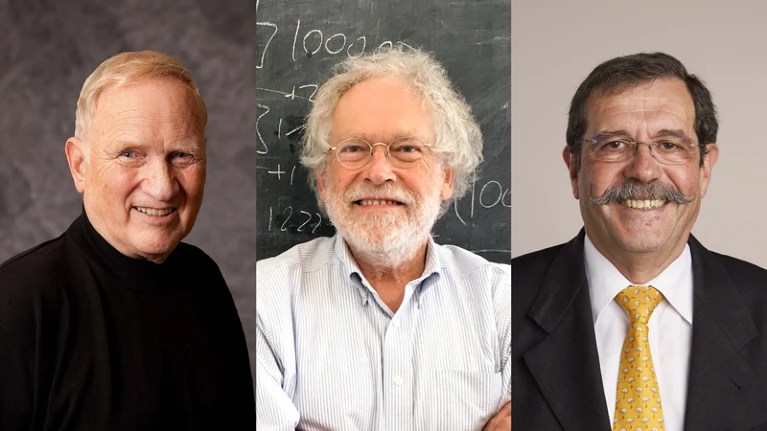
John Clauser, Anton Zeilinger and Alain Aspect have won this year’s Nobel physics prize for their research on quantum entanglement
We would like to congratulate Alain Aspect, John Clauser, and Anton Zeilinger for winning the 2022 Nobel Prize in Physics! The prize was awarded for “experiments with entangled photons, establishing the violation of Bell inequalities and pioneering quantum information science”—a very exciting development for our field!
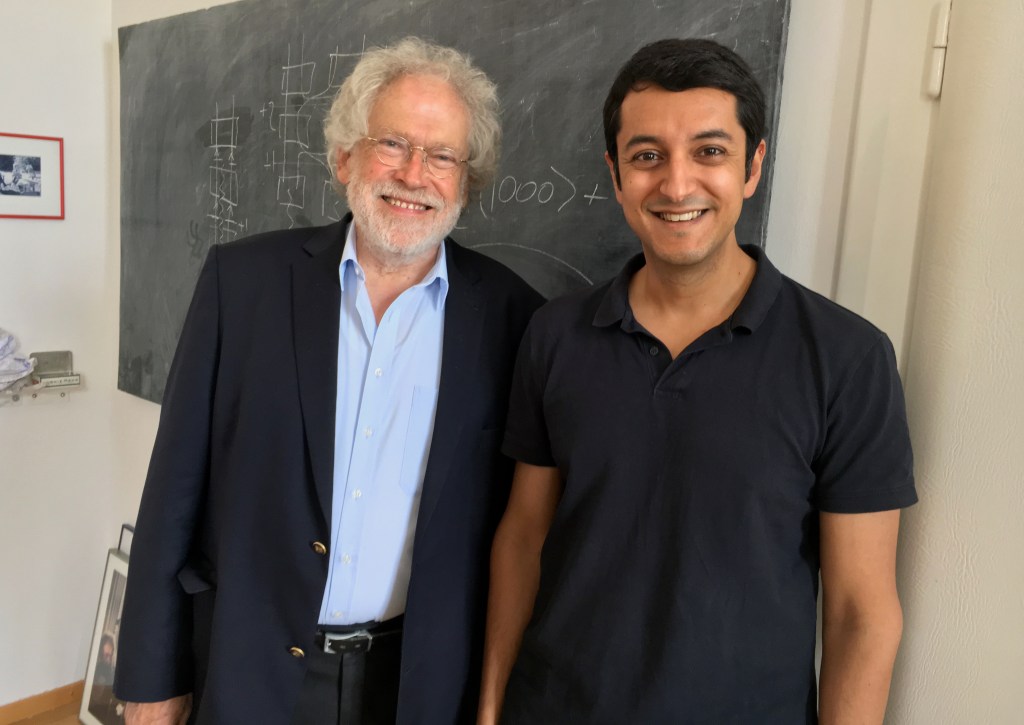
Congratulations Anton!
A very special congratulations goes out to Professor Zeilinger, whom Mehul spent several years working with in Vienna, before moving to Edinburgh and starting the BBQ Lab. In recognition of the award, the Nature portfolio of journals has put together a beautiful collection of articles by the awardees and advances they have inspired. We are pretty chuffed to see four of our papers in there (two authored with Anton, and two from our group at Heriot-Watt)!
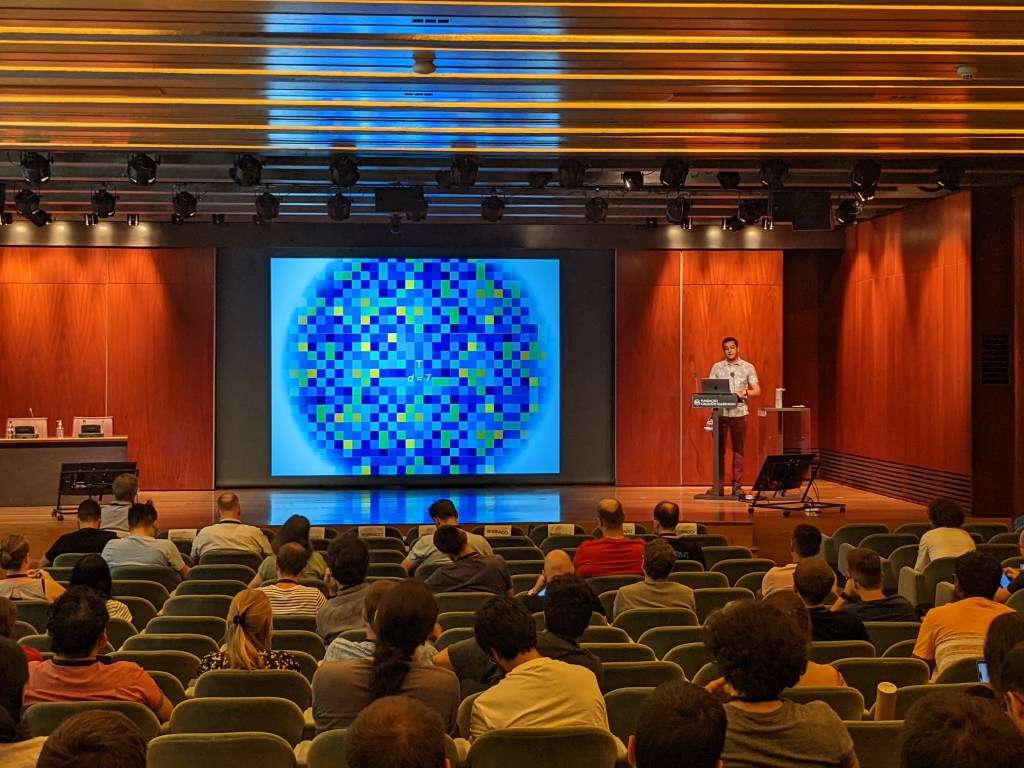
We recently had the privilege of attending the 15th International Conference on Quantum Communication, Measurement and Computing (QCMC) in beautiful Lisbon, Portugal. The conference was held in the Calouste Gulbenkian Museum, an incredible venue surrounded by lush gardens. Mehul presented a joint talk with Marcus Huber on “High-Dimensional Entanglement for Quantum Communication” and there was a strong showing in the poster session with posters from Suraj, Natalia, Sabine, and Mehul. A big congratulations to Andreas Winter for winning the prestigious International Quantum Award, along with Giacomo Mauro D’Ariano and Mikhail Lukin. We are looking forward to QCMC 2024 in Chennai, India!
Starting off the conference with some Vinho Verde!




 BBQ Lab