BBQ Lab members Dr. Will McCutcheon and Mariana Annameng Ma had the exciting opportunity to meet UK Science Minister Lord Patrick Vallance, along with a cohort of early career researchers from the Institute of Photonics and Quantum Sciences (IPaQS) at the Heriot-Watt University, here in Edinburgh. They presented our group’s research on the development of high-dimensional quantum technologies.
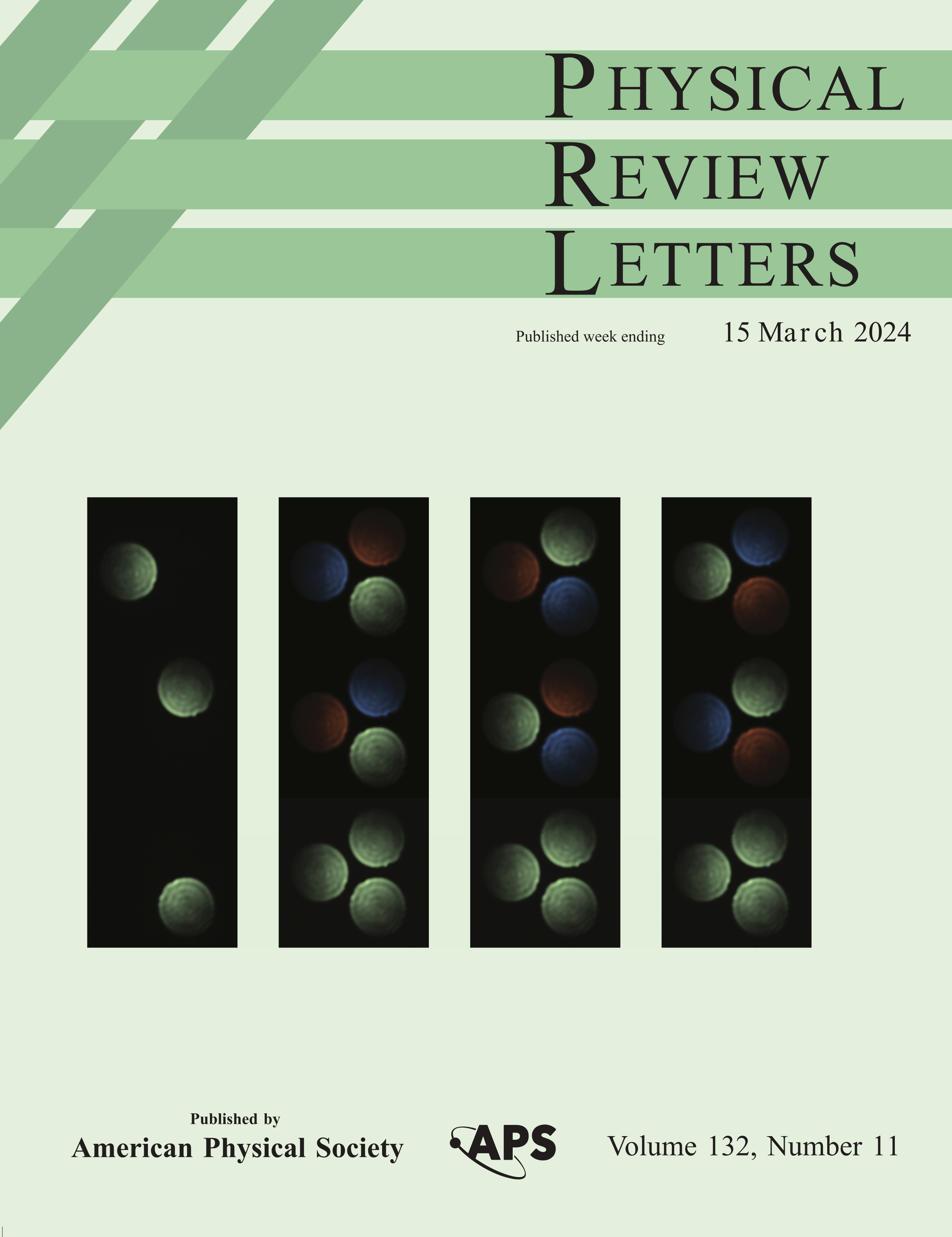
We’re very excited to share that our recent work was published in Physical Review Letters while also being highlighted on the cover of the journal!
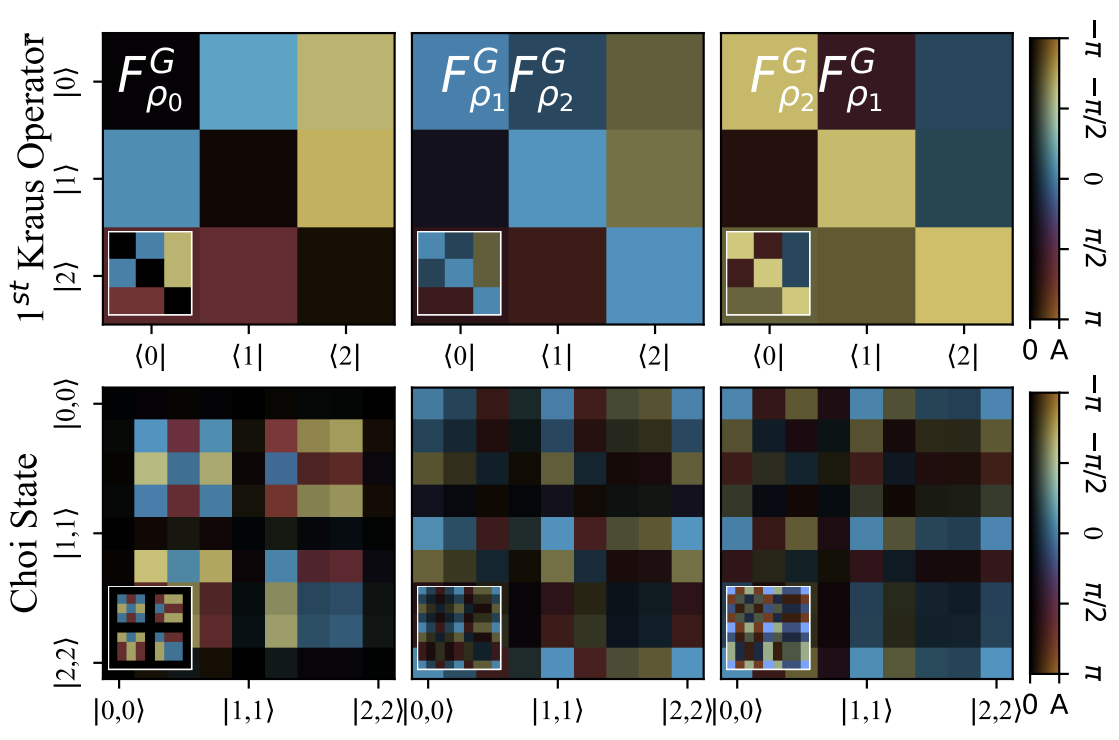
In this collaboration with groups from University of Leeds and Imperial College London, we program high fidelity non-unitary qutrit operators inside a multi-mode fiber, simulating fusion and braiding of non-Abelian D(S3) anyons. For this to work, we combine techniques developed in our previous works such as characterizing multi-mode fibers, designing non-unitary operations, as well as programming optical circuits.
We’re very excited to share our latest work that was recently published in Nature Physics! Here we program optical circuits in a disordered medium by employing the disorder itself. We use these optical circuits to manipulate, and efficiently measure, high-dimensional entangled qudits.
A complex medium consists of millions of unitary operations within itself. Our method very carefully directs light through any combination of these operations, effectively programming a new arbitrary operation. This allows us to perform any set of quantum gates on high-dimensional states of light, including the ones necessary for entanglement certification and efficient quantum measurement.
This paper is very dense in terms of the variety of techniques involved in the theoretical formulation, experiment, simulations, data analysis, and computation, and most importantly, error analysis. This work was done along our collaborators Armin Tavakoli, Claudio Conti, and Pepijn Pinkse.
You can read the open access paper by following this link 10.1038/s41567-023-02319-6 . The codes and dataset used for the simulations in the paper are available on Github.
Our work was recently published in Optics Express and was highlighted as the Editor’s Pick. In this work, we present a method to fully characterize the transmission matrices of complex media using neural networks.
While similar methods existed, few of them could measure the relative phases between rows of the transmission matrix. Relative phases are necessary for coherent control of light after it propagates through given complex media, allowing their applications in optical networks, biomedical imaging, and quantum information processing.
Doing simple modifications to our setup and performing randomised measurements allows full recovery of transmission matrix using (what we call) multi-plane neural networks (MPNN). We show that our technique performs a much more accurate measurement as compared to the standard existing method of measurements on the same physical setup. Moreover, our technique is extremely robust to noise, retrieving a high-quality transmission matrix even when the measured data is majorly just noise (upto SNR =0.8)!
We also demonstrate the scalability of this method, to characterize multiple complex media simultaneously in a highly non-trivial and non-convex system.
You can read more about this work which is open access at doi.org/10.1364/OE.500529 . We have included all the codes, experimental and simulational datasets with the paper which can be found on Zenodo.
Evolution of three input modes in red, green and blue that are sorted into respective outcomes with their overlap sorted into the ambiguous outcome that turns white.
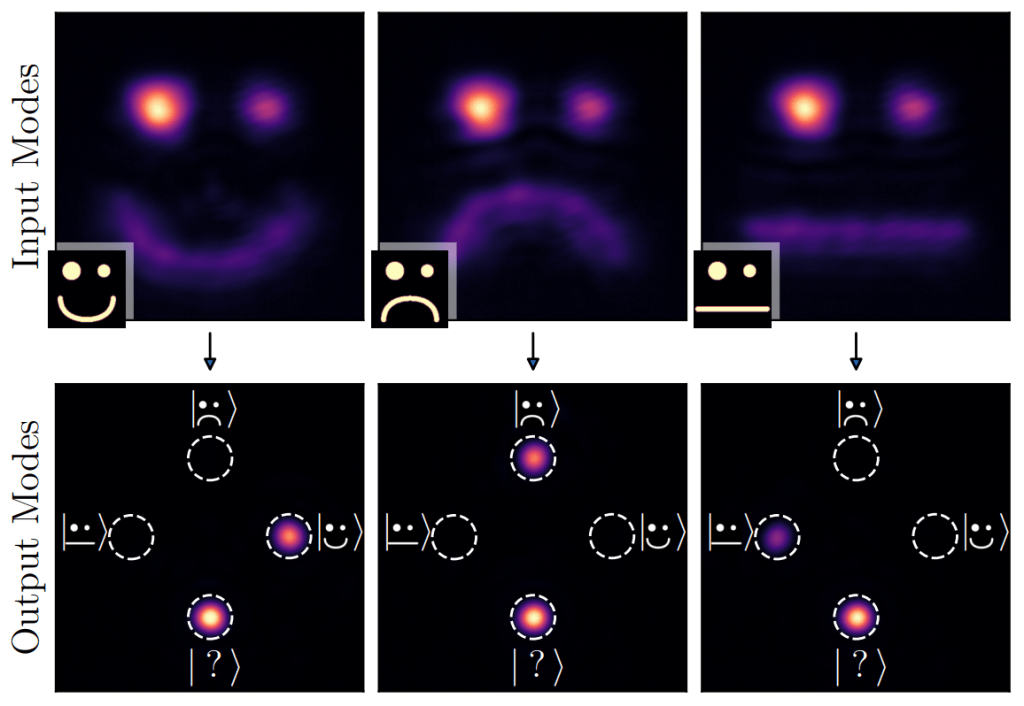
We are excited to announce that our latest work ‘Simultaneously Sorting Overlapping Quantum States of Light‘ has been published in Physical Review Letters. In this collaboration with the QOCI Group, we demonstrate simultaneous and efficient sorting of non-orthogonal transverse-spatial states of light in up to seven dimensions. This has been made possible by employing a multi-plane light converter (MPLC) to program high-dimensional POVMs that correspond to unambiguous discrimination of the quantum states. The MPLC employs an additional auxiliary outcome that sorts the overlap of all the modes into an ambiguous outcome.
An implication of this method is that we can sort overlapping images encoded with coherent sources. We demonstrate this by sorting three smiley faces with an accuracy of 97.6%, implying accurate image classification with light!





 BBQ Lab